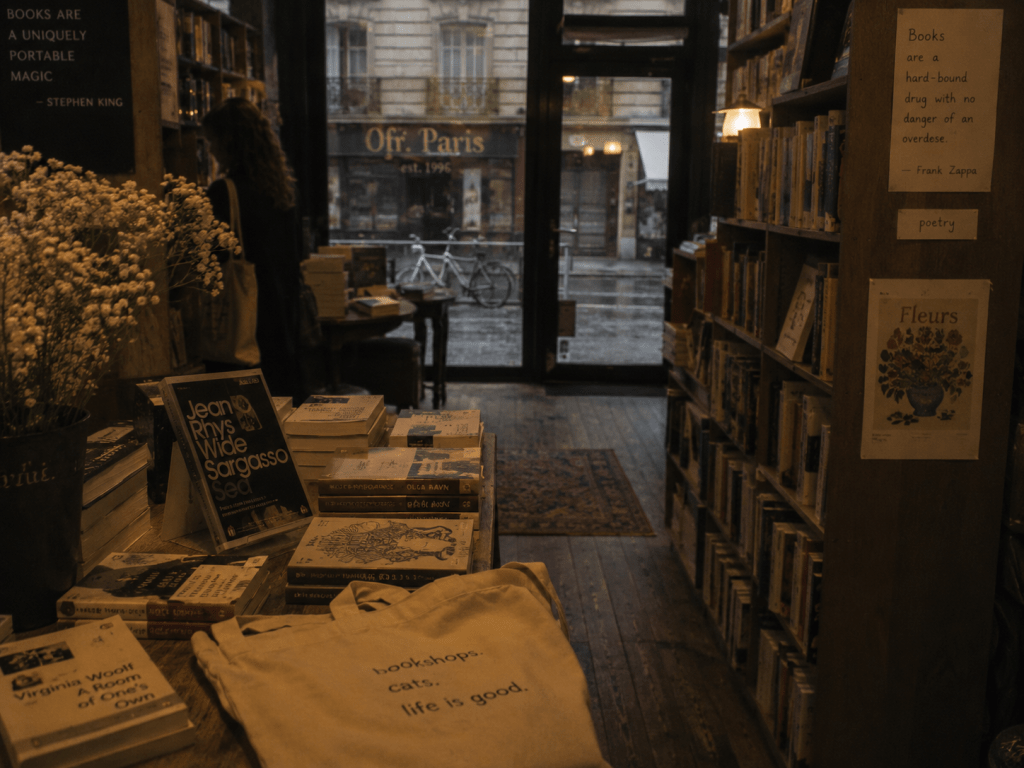
Everything becomes quieter inside a bookstore.
Not silent, exactly, but softened.
A bookstore feels like a foyer between worlds, an antechamber separating reality from hundreds of other possible lives. Every shelf is a doorway into another person’s mind, another city, another grief, another version of existence entirely.
Some people walk into bookstores looking for entertainment.
I think certain girls walk into bookstores looking for understanding.
I have always been one of those girls.
Whenever I enter a bookstore, I instinctively gravitate toward essays, feminism, social commentary, psychology, books that dissect people and society with uncomfortable honesty. I love fiction too, but I am especially drawn toward books that make me feel intellectually and emotionally exposed at the same time.
The strange thing is that sometimes simply existing around books feels just as comforting as reading them.
Building a constantly expanding TBR list, holding a paperback while drinking coffee, slowly wandering through shelves without urgency create a very specific kind of peace. Even now, in the era of decorated e-readers and digital libraries, bookstores still feel deeply nostalgic to me.
And trust me, I fully participate in the aesthetic absurdity of modern reading culture. My e-reader has stickers, charms, a sparkly case, a matching pop socket, the full experience. But no amount of convenience replicates the serotonin of a physical book. The smell of paper, the weight of it in your hands, the feeling of turning pages while sitting in a café somewhere quiet.
It feels human in a way digital spaces rarely do.
I think bookstore girls are often misunderstood as escapists.
And maybe we are, partially.
But I do not think women become emotionally attached to books, essays, music, films, and art simply because they want to escape reality. I think many women use art to understand reality more deeply.
Sometimes books explain our own emotions back to us in better words than we could have ever found ourselves.
That is why reading can feel almost physical.
You are not just consuming a story. You are recognizing yourself inside someone else’s observations.
You are finally breathing.
I think many women build emotional intelligence through art long before life gives them the language for their feelings. We search for stories that reflect us back to ourselves because reality often feels emotionally insufficient. Most people move through life trying not to feel too much. They stay emotionally safe. Measured. Detached.
But bookstore girls are usually the opposite.
We are constantly searching for intensity, honesty, vulnerability, meaning.
And maybe that is why reality disappoints us sometimes.
Because once you have experienced emotional depth through literature, ordinary emotional superficiality becomes impossible to ignore.
Books taught me this long before people did.
Pachinko by Min Jin Lee taught me about suffering, sacrifice, shame, prejudice, unconditional love, and the quiet brutality of survival. It made me realize how fortunate some people are to never have their humanity questioned because of where they come from or how they look.
I Who Have Never Known Men by Jacqueline Harpman felt like staring directly into the absurdity of existence itself. A reminder that sometimes life offers no explanation, no closure, no greater meaning beyond surviving and continuing anyway.
Crying in H Mart by Michelle Zauner explained grief in a way that felt devastatingly intimate, especially the kind of grief connected to family, identity, and belonging.
The Son of Man by Jean-Baptiste Del Amo made me think deeply about generational trauma and the invisible emotional inheritance passed from parents to children.
Trust by Hernan Diaz reminded me that storytelling itself can become manipulation, perspective, performance, and power. It was one of those rare books where the structure itself feels like art.
Capitalist Realism by Mark Fisher articulated the exhausting psychological reality of existing under modern capitalism better than many political conversations ever could.
And books like Men Explain Things to Me by Rebecca Solnit, Bad Feminist by Roxane Gay, Men Who Hate Women by Laura Bates, and Invisible Women by Caroline Criado Perez gave me something equally important: the realization that many women are not imagining their discomfort with the world around them.
Sometimes feminism does not begin with anger.
Sometimes it begins with relief.
The relief of realizing:
I am not crazy. Things really are difficult in ways nobody fully explained to me before.
Books like Flesh by David Szalay ask uncomfortable questions about fate, loneliness, desire, and whether we truly choose the people who shape our lives.
Trick Mirror by Jia Tolentino helped me understand that constant self-optimization is not the same thing as happiness, especially for women raised to see themselves as permanent self-improvement projects.
Salt Houses by Hala Alyan explores displacement, family, and identity in ways that feel simultaneously culturally specific and universally human.
What We Talk About When We Talk About Love by Raymond Carver reminded me that hope often survives quietly, hidden inside ordinary conversations and small moments.
Swimming in the Dark by Tomasz Jedrowski captures love, oppression, resistance, and the painful reality that sometimes survival demands impossible choices.
And Madonna in a Fur Coat by Sabahattin Ali understands something many bookstore girls secretly ache for: quiet love, emotional depth, and the invisible weight people carry inside themselves every day.
Maybe that is why bookstore girls often seem emotionally attached to fictional worlds and essays. We are not necessarily searching for fantasy. We are searching for articulation. For someone capable of expressing the things we already felt but could not fully name yet.
And honestly, there is something slightly avoidant about us too.
I think many bookstore girls run toward books because reality feels emotionally underwhelming compared to the emotional honesty they find inside stories. Real life often demands restraint, politeness, emotional moderation. But books allow people to feel everything fully: obsession, loneliness, grief, desire, rage, hope.
Inside books, emotions are allowed to become enormous.
Maybe that is comforting for women who spend so much of their lives trying to remain emotionally manageable.
My ideal afternoon is probably embarrassingly predictable. Sitting inside Cărturești Carusel with a good coffee and a witty essay collection, mentally yelling “exactly!” every few pages because some woman I have never met somehow understands my most recent existential crisis perfectly.
That is the magic of books.
Not escape.
Recognition.
Maybe girls who love bookstores are really just searching for places where feeling deeply is still allowed.
 Pink Collar Thoughts
Leave a comment